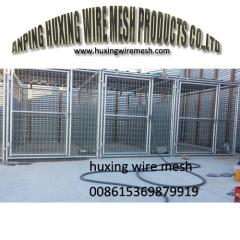
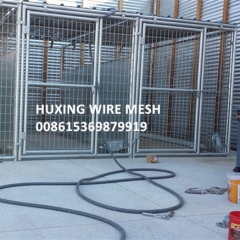
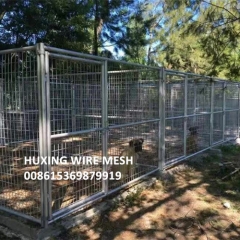
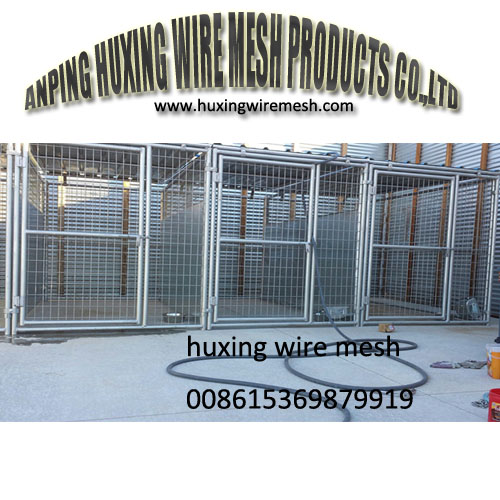
Kennel Overview
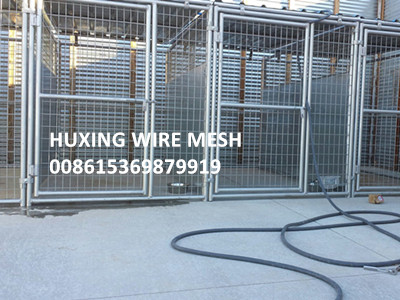
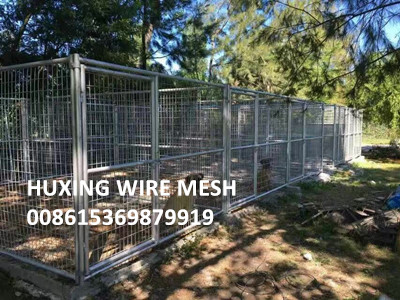
A heavy duty multiple run dog kennel is one welded frame split into separate runs, so several dogs can be housed side by side without sharing the same floor. The fight guard divider is what makes the difference: each dog keeps its own run while the block itself stays a single rigid structure, with straight lines and a compact footprint instead of a row of separate cages.
Built to stay outside, this outdoor steel dog kennel uses round tube frames and welded wire infill, hot-dip galvanized so the frame and the mesh carry the same protection against weather and rust. You get the silver-grey colour of galvanized steel rather than a painted finish, which suits yards, farms and working facilities where the kennel is never brought in.
It arrives as steel dog kennel panels — ends, sides, gates and the divider — that stand on the ground and clip together on site, and they stack for shipping, so a full block travels as a manageable load rather than a finished cage.
Distributors and importers ordering wholesale steel dog kennels usually settle two questions before anything is quoted: how many runs, and how heavy the wire and frame need to be. Both are decided at the drawing stage here, which is why the block you receive matches the one you specified.
Fight Guard Divider Function
- Separate runs, one frame. The divider sits inside the block and divides it into two, three or more runs. Each dog gets its own space while the frame stays one unit, which is quicker to set out and easier to keep square than separate cages pushed together.
- No contact, no crossed lines. Dogs on either side of the divider have their own run and their own gate, so an animal that guards food or does not tolerate company can be housed next to the group without being housed with it.
- A gate for every run. Each run is entered through its own hinged gate with a latch, so one dog can be moved, fed or cleaned around without opening the run next door.
- Run count set at order. Two runs, three runs or more — the block is built to the number you need, and the divider positions are fixed on the drawing before the frame is welded.
- Runs come out equal. Divider positions are set out rather than guessed, so every run in the block is the same size and the gates line up along one face.
- Planned as a multiple run dog kennel from the start. Run count, run size and gate positions are decided together, so the block is drawn as one assembly rather than adapted afterwards.
- Cleaning between runs. With a divider in place you can hose out one run, change bedding or treat a dog without disturbing the run next door — useful where one dog is on medication or on a different feeding routine.
- A fight guard dog kennel for intake and recovery. The format suits a new arrival, a bitch with a litter, an injured dog or an animal that has to be kept apart for a few weeks, because the separation is built into the kennel instead of improvised with temporary panels.
Frame, Mesh & Galvanizing
The infill is welded wire: every crossing is fused, so each opening stays square and the panel holds its shape when a dog pushes against it. A weld wire dog kennel built this way also keeps a clean, readable line along the divider and the gates, which matters on a yard where several dogs are visible at once and behaviour is easier to read through a regular grid.
Wire and frame are chosen separately. Gauge 8 is the standard infill; gauge 6 is the heavier wire and the usual pick where large or boisterous dogs hit the mesh rather than lean on it. The frame comes in 32 mm, 38 mm or 42 mm round tube, and the 42 mm frame is the one to take for boarding, breeding and working kennels where the block is in constant use.
As a steel dog kennel manufacturer we keep the finish simple on this model: hot-dip galvanizing and nothing else. There is no paint or powder coat to chip along the bottom rail, which is where a kennel usually starts to go first. Look at the finished surface against your own standard before a large order — galvanizing reads matte and slightly uneven next to a painted panel — and if a painted finish is a requirement for your market, raise it at the drawing stage so we can tell you what is possible.
Steel Roof Cover
- Rain and sun off the run. The steel roof cover sits over the fight guard dog kennel and shelters every run beneath it, so dogs stay dry in wet weather and have shade when the sun is high.
- Drier floors, less mud. A covered run dries out faster underfoot, which means less bedding changed and less mud carried back across the yard.
- Shade where there is none. Where the outdoor steel dog kennel stands away from trees or a building, the cover is often the only shade the dogs get through the middle of the day.
- Sized to the block, not to one run. The cover is ordered to the run count, so a two-run and a four-run block are each covered end to end instead of leaving one run open.
- Made for this panel system. Because the cover is built around the same steel dog kennel panels, it follows the frame you already have rather than needing a separate structure beside it.
- Optional on the order. Plenty of buyers take the block open-topped where it sits under an existing shelter; the roof is an addition, so say whether you want it when the drawing is confirmed.
- Ask about fixing and support. If the site sees heavy snow, exposed wind or a raised base, request the roof fixing and support details with your drawing so the cover suits the conditions it will meet.
Typical Applications
Wholesale steel dog kennels of this type usually go to two kinds of buyer. Distributors and importers stock the block because a panel system travels as flat sections and can be sold as a two-run or a four-run set from the same parts. Yards and facilities buy it because the runs are already divided when the kennel arrives, so the layout works on the first day rather than after a season of rearranging.
Breeders, working-dog owners and small boarding setups are the core users of a fight guard dog kennel — anyone keeping several dogs that must stay separate but housed in the same block, close enough to be fed, checked and moved without a walk across the yard.
Facilities running several dozen dogs, such as boarding kennels, rehoming centres and working-dog units, generally buy this block in multiples so the yard behaves the same everywhere. As a steel dog kennel manufacturer we hold one panel specification across those blocks, so a second or third order matches the first instead of drifting in gauge, tube or finish.
Specifications
| Item No. | HXDK-HRUNS |
| Kennel type | Multiple run block with fight guard divider |
| Unit run size | 5' W x 6' H x 10' L; 4' W x 6' H x 8' L |
| Run count | Two, three, four or more runs to order |
| Frame | Round steel tube, 32 mm / 38 mm / 42 mm diameter |
| Wire gauge | Gauge 6 or Gauge 8 |
| Mesh opening | 2" x 2" or 2" x 4" |
| Surface finish | Hot dip galvanized |
| Gates and fittings | Hinged mesh gates, connection clips, latches |
| Roof | Steel roof cover, ordered to match the run count |
| Assembly | Panel system, clipped on site |
| Run sizing | Runs modular to requested size |
Run Sizes & Modular Build
- Start from the unit run.
- Count the dogs, then count the runs. Each divider creates one more run, so a three-run block needs two dividers inside the same frame.
- Fix the layout direction. A multiple run dog kennel grows across the divider line, so runs sit side by side in one frame rather than in a long chain of separate kennels.
- Place the gates where you work. Put each run's gate on the face you use most and keep the feeding side clear, so one dog can be taken out without leading it past the others.
- Match run depth to the dogs. A 10 ft run gives a dog room to move along the panel; an 8 ft run is usually enough for a single dog or a smaller breed, and it shortens the block where ground is tight.
- Send the footprint. As a custom dog kennel supplier we set the block out to your own length, width and run count, using the same panel system rather than a new design.
Installation & Site Preparation
- Set a firm, level base. Compacted gravel, a concrete slab or level hardstanding all work; what matters is that the frame does not sit on soft ground that will settle under a dog.
- Lay out the parts in the order they will stand — end panel, side panels, divider, gates — and check the count against the drawing before you start clipping.
- Stand the first of the steel dog kennel panels and the side panel next to it, hold the corner square, and fit the connection clips.
- Add the divider at its marked position, then the remaining side and end panels, checking that each run comes out the same size.
- Hang the gates and test every latch; a gate should close without lifting or dragging on the ground.
- Fit the roof cover last if you ordered one, working from the middle of the block outwards.
- Walk the whole frame, check the diagonals against each other and re-tighten the clips after the first week, once the ground has bedded in.
- Plan for moving it. Because the block is clipped rather than welded on site, it can be taken down, carried to a new position and rebuilt on fresh ground when a yard is reorganised.
Ordering & Delivery Notes
- Send the layout first. Confirm the run count, unit run size, wire gauge, tube diameter and whether the steel roof cover is wanted. We return a drawing for your approval before the panels are made.
- Order quantity. Ask your sales contact what order quantity applies to your configuration; it changes with run count and with whether the panels are made to a non-standard footprint.
- Production and delivery schedule. Confirm the current schedule in writing before you commit to a site date, since the block is made to order rather than picked from stock.
- Payment and shipping terms. Payment method, deposit and balance arrangements, and the shipping terms for your port are set out in the quotation. Ask for them in writing with the drawing so nothing is agreed verbally.
- Warranty and after-sales scope. Ask what the warranty covers and how after-sales is handled in your market, and keep the answer with your purchase order.
- Standards and test reports. If a tender or your own customer needs a standards reference, a test report or a declaration, say so at enquiry stage so we can confirm what can be supplied for this model.
- Weight and loading. Unit weight, panel weight and how many blocks load into a 20GP or 40HQ all change with gauge and run count, so request the figures with the drawing rather than estimating from the picture.
- Load figures. If you need bearing or roof load figures for snow, a raised base or very heavy dogs, ask for them at the same time and we will confirm what is available.
- Packing and marking. Panels are supplied as flat sections for shipping. Confirm bundle counts, crate or pallet format, and any marking or labelling your warehouse needs.
- Repeat business. Distributors ordering wholesale steel dog kennels usually keep one specification on file so the next container matches the last. Ask for the specification sheet in PDF to hold alongside your purchase order.
- Custom blocks. As a custom dog kennel supplier we work from your footprint: send a simple sketch with overall length, width, height and run count, and the drawing comes back for confirmation before production.
Supply Chain & Delivery Assurance
Anping Huxing Wire Mesh Products Co., Ltd. is a factory-direct manufacturer and exporter working out of Anping, Hebei, the wire mesh producing region of northern China. Orders are built to your drawing rather than picked off a shelf, and because the lines sit in the same production cluster we can bring several categories into one schedule and one consolidated container, packed, marked and labelled the way your market needs — neutral and private-label formats included. Send sizes, quantities and the delivery window you are quoting against; we reply with what can run together, when it ships, and the loading plan.
FAQ
Can dogs see each other through the fight guard divider?
Yes. The block is built from wire panels throughout, the divider included, so a dog can see and smell the run next door but cannot reach it. That suits animals that settle better with company in view, and it lets you read behaviour across the block while you work. If one dog needs to be screened from the others, tell us at the drawing stage and we will say what can be done within the same frame.
Should I choose 2" x 2" or 2" x 4" mesh opening?
The 2" x 4" opening is the standard for adult dogs and gives the most open view into the run. The 2" x 2" opening closes the gap for puppies, small breeds and dogs that try to push a head or a paw through. Both are available on this weld wire dog kennel in the same wire gauge, so the choice is about the dogs you keep rather than about the strength of the frame.
Can I mix 4 ft and 5 ft runs in one block?
Blocks are normally built from one unit run repeated, because that keeps the frame square, the gates lined up and the loading straightforward. A mixed block can be drawn where the ground demands it, and as a custom dog kennel supplier we will tell you plainly whether the mix earns its extra cost for your layout or whether two separate blocks work better on the same site.
Do I need to weld anything on site?
No. This weld wire dog kennel assembles with connection clips and latch fittings, so it can be taken apart and rebuilt again without cutting steel. Two people can raise a two- or three-run block; a longer block goes up faster with three, mainly so the panels can be held square while the clips go on.
Does the hot-dip galvanized finish need painting?
No. Galvanizing protects the steel on its own, and the surface settles into a flat grey as it weathers. Check the frame after heavy impact — a dog working at a weld, or a gate catching a vehicle, is where the coating is most likely to be marked — and touch in any bare steel so the damaged spot does not become the weak point of the panel.
Can I order this kennel with a powder-coated finish?
This outdoor steel dog kennel is supplied hot-dip galvanized only, which is the finish most suitable for wet, open sites. If a colour matters for your market, raise it when you ask for the quotation: other kennels in our range are finished galvanized then PVC powder coated, and we will tell you what is available for the size and run count you need.