Product Overview
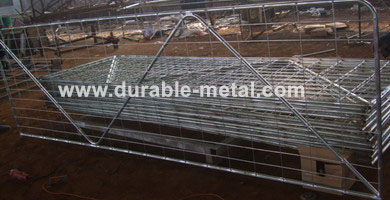
An N brace farm fence is the gate a working farm actually uses every day: swung open for a ute or a tractor, lifted off its posts for a fencing repair, carried to a break in the paddock and dropped into place. The 1170 mm welded mesh fence panel is a welded steel grid — 100x200mm farm fence mesh — set into a folded tube frame, so it keeps its shape when it is lifted instead of rolling up like netting, and one person can shift it without waiting for a second pair of hands.
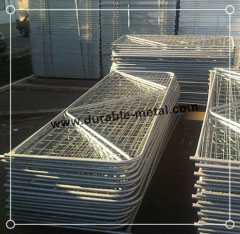
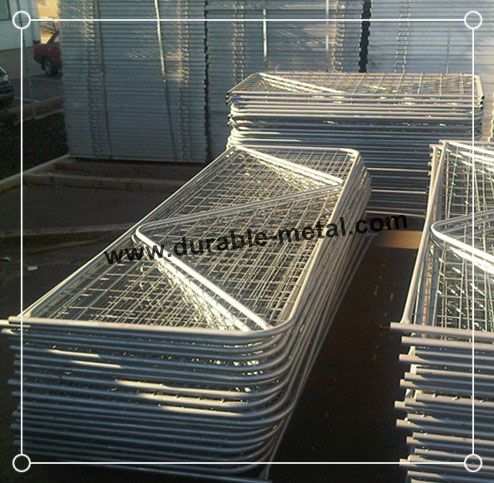
Nothing about it needs a post driver or a concrete footing to be useful. Two people unload it, one person walks it into position, and a run of gates stacks flat in the shed until the next job — or in the container, on a galvanized farm fence wholesale order. It works as a permanent paddock gate, as a movable break between grazing cells, or as a plain stock barrier where a fence line has failed.
As an n brace farm fence manufacturer we build the frame, the mesh and the stay as one welded piece, so what arrives is a finished panel ready to hang rather than a kit to assemble.
Manufacturing Process
- The mesh comes first: wire is welded at every crossing to give the 100x200mm farm fence aperture, then the corner wires are cut back clean so nothing stands proud of the panel.
- The pipe is cut to length, flattened and folded at the corners. As an n brace farm fence manufacturer we form the frame from one piece of tube rather than joining separate corner fittings, so each corner is continuous steel.
- The pipe frame is welded into a closed rectangle.
- The welded mesh panel is set into the frame and welded along its edge, so the grid and the frame behave as one unit rather than a net stretched over a hoop.
- Every weld is dressed back. This is not cosmetic — a polished weld gives stock nothing to rub against and leaves no pocket where water can sit.
- The dressed welds are touched in with silver paint so the joins match the galvanized surface of the wire and pipe.
- Each panel is checked for square and flat before it is stacked. A twisted frame is easier to find on our own floor than in your paddock, and the check is the same whether the panel is going out alone or as part of a galvanized farm fence wholesale order.
N Stay/Brace Farm Fence
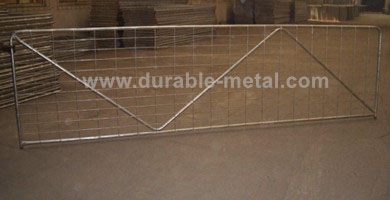
The N stay is the diagonal member welded across the frame, and it is the reason a long gate still closes cleanly after a few seasons. A plain rectangle always tries to drop at the free end: the weight of the 100x200mm farm fence mesh and the swing of the gate pull it out of square, the far corner starts catching the ground, and the gate is never quite shut again. Welding a stay across the diagonal turns that rectangle into two triangles, and the panel can no longer rack.
That matters most on the longest panels. A short gate barely needs the help; at the top of the range the stay is what keeps the top and bottom rails parallel season after season. You notice it when the gate is half open and unsupported — a braced frame stays where you put it, while an unbraced one sags away from you.
The stay is welded into the frame at both ends rather than bolted, so there is nothing to tighten, nothing to lose in the grass and nothing that works loose as stock lean on it. The whole panel goes out as one piece of steel, with the welds dressed back and touched in so the joins match the galvanized surface.
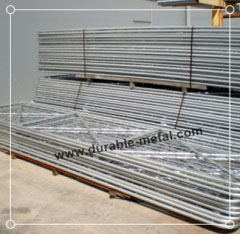
Because the frame stays flat, a stack of braced panels sits neatly on a pallet and comes off one at a time. Nothing has to be straightened on site before it is hung, which is the part that matters when a gate has to go up alone at the end of the day.
- What the I stay does: a straight stay is set into the frame instead of a diagonal one, so the panel is symmetrical and hangs the same way from either end. - Same fence underneath: the I stay version uses the same wire, mesh, frame pipe and overall height as the N braced panel, both built to the same Australia standard farm fence — only the bracing pattern changes. - Where a straight stay suits: double gates, matching pairs either side of a lane, and openings where a diagonal member would sit in the way of the swing or catch on a gate stop. - Where the diagonal wins: on the widest single leaves the N stay resists racking better, so if you are ordering one very wide panel, take the N braced version. - Outdoor build: both versions are a hot dipped galvanized farm fence, with galvanized wire and pipe doing the work outdoors and only the dressed welds touched in silver. - Choosing between them: tell us the clear opening, whether the gate hangs alone or as one of a pair, and what has to pass through it, and as the n brace farm fence manufacturer we will confirm which stay we would fit to that panel.
Farm Gate Length Options
- Seven lengths of n brace farm fence panel cover everything from a hand gate to a farmyard entrance.
- 900: the smallest panel, for pedestrian gaps, small holding pens and tight yards where a full gate will not swing.
- 1200: a walk-through opening between paddocks, or a garden and orchard gap you open by hand.
- 2400: the workhorse — a normal single paddock gate that one person can still lift off its posts.
- 3000: a wider opening that takes a quad and trailer or a small tractor without clipping the posts.
- 3600: machinery access and field-corner gaps where a baler or a loader has to pass through.
- 4200: wide laneway crossings and openings that carry both stock and implements.
- 4800: the widest standard panel, for farmyard entrances and big implement or truck access.
- Measuring: take the clear post-to-post width of the opening, not the size of the old gate. If the new gate has to swing back against a wall or a bank, leave room for that swing before you fix the length.
- When you are between sizes: go up for a machinery opening and down for a stock pen, and remember the panel can be re-hung on a different opening later.
Farm & Site Applications
- Livestock paddocks: a gate between grazing cells, a bull pen, a race end, or a barrier across a gateway while a mob is moved.
- Crop and vegetable protection: a movable barrier at a vegetable block, an orchard or a bale stack, and a quick fix where a fence line has been pushed over.
- Farmyard and machinery lanes: closing a lane a vehicle keeps cutting across, screening a fuel tank or dividing a yard without building a permanent fence.
- Parking and public safety: off the farm, the same welded mesh panel works as a parking barrier, a showground divide and a site compound fence where a permanent structure is not justified.
Specifications
| Specification | Value |
|---|
| Item number | DMFMF01 |
| Type | N brace farm fence panel, welded mesh |
| Build standard | Australia standard farm fence |
| Dimensions | All measurements in millimetres |
| Brace | N stay/brace; I stay/brace version also available |
| Wire diameter | 5 |
| Mesh aperture | 100 × 200 |
| Frame pipe | Φ32 × 2 |
| Overall height | 1170 |
| Lengths | 900, 1200, 2400, 3000, 3600, 4200, 4800 |
| Material | Hot dipped galvanized steel wire and steel pipe |
| Finish | Hot dipped galvanized; welded spots polished and touched in silver |
| Typical use | Livestock enclosure, crop and vegetable protection, parking and public-safety barrier |
| Main markets | Australia, New Zealand, South America, Europe |
Handling, Storage & Care
Two people carry a standard gate comfortably and one person can shift a short one, but move it on a sack barrow rather than dragging it — pulling a panel across concrete scuffs the coating off the bottom rail, which is exactly where rust starts. In the shed, stack flat on a pallet or on bearers with the mesh up and clear of wet ground; a panel left leaning against a wall for a month is how a frame picks up a twist.
Keep the foot of the gate clear of soil, manure and wet straw. Moisture held against the lowest wire is the usual cause of an early rust line, and clearing the gate line once a season costs nothing. This is a hot dipped galvanized farm fence, so the coating takes weather that would send a painted panel back to bare steel — but a deep scratch down to bare metal is still worth dabbing with a zinc-rich repair paint before rust settles in. When a gate begins to drag, check the hinge, the pin and the post before blaming the panel; those take the wear, and a straight post solves more dragging gates than a new panel does.
Ordering & Delivery
- Send the clear opening width, measured post to post, together with the quantity and the lengths you want.
- Describe the job — stock, crops, machinery or parking — and whether the gate hangs alone or as a pair. We build to the opening you send rather than to a shelf size, so a width that is not quite standard is a normal request.
- Confirm what is supplied with the panel. The gate is quoted as a panel; posts, hinges, pins and latches are separate decisions that depend on your fence line, so tell us what it has to hang on.
- Ask for the loading plan with the quotation: pieces per bundle, pieces per container and the weight of a bundle are worked out per order rather than fixed in advance.
- Agree the commercial terms in writing — minimum order quantity, production and delivery time, payment terms and what the after-sales scope covers. We are a welded farm fence supplier working to your schedule, so the delivery window you are quoting against should be on the table from the first message.
- Say early if the order is for a tendered or inspected project, and ask which test reports or inspection documents can be provided with it.
- Send the full size mix in one list. For a galvanized farm fence wholesale order the container is planned once, and a mix that arrives in three separate messages is how pieces get left off the load.
Supply Chain & Delivery Assurance
Anping Huxing Wire Mesh Products Co., Ltd. is a factory-direct manufacturer and exporter working out of Anping, Hebei, the wire mesh producing region of northern China. Orders are built to your drawing rather than picked off a shelf, and because the lines sit in the same production cluster we can bring several categories into one schedule and one consolidated container, packed, marked and labelled the way your market needs — neutral and private-label formats included. Send sizes, quantities and the delivery window you are quoting against; we reply with what can run together, when it ships, and the loading plan.
FAQ
Can I order a length that is not on the list?
The seven standard lengths cover most paddock openings, and anything between them is normal production for us — as a welded farm fence supplier we cut and weld to the opening rather than only to a catalogue. Send the clear post-to-post width and we will confirm what can be built; on very short or very wide one-offs the stay pattern may need to change, which is worth settling before the order goes into production.
What is the difference between the N stay and the I stay?
Only the bracing inside the frame changes. The N stay runs a diagonal member across the panel, splitting the rectangle into two triangles so the frame cannot rack — the version to take on wide single leaves. The I stay uses a straight stay instead, giving a symmetrical panel that hangs the same way from either end. Order either as the n brace farm fence panel for wide single openings, or as the straight-stay version for pairs and double gates; wire, mesh, frame pipe and finish are identical.
Does the gate come with posts, hinges and pins?
The gate is the welded mesh panel itself — frame, mesh and stay. Posts, hinges, pins and any latch depend on the fence line it hangs on and can be quoted with the panel or supplied on their own. Tell us the post you are using and the clear opening, and we will confirm what the gate needs to hang and swing cleanly.
Will the finish stand up to wet ground or coastal air?
Hot dipped galvanized wire and pipe is the right starting point for outdoor work: the zinc coating goes before the steel does, so the panel keeps its shape through weather that would take a painted finish back to bare metal. This is a hot dipped galvanized farm fence rather than a powder-coated one, which suits wet yards, coastal salt air and stock areas that get hosed down. Two habits make it last longer — keep soil and manure off the bottom rail, and touch any deep scratch with a zinc-rich repair paint before rust takes hold.
Is the 100 × 200 mm mesh right for sheep and lambs?
The mesh is sized for cattle, sheep, goats and horses at the shoulder: it holds mature stock and lets wind through instead of acting as a sail. It is not a lambing or poultry mesh — a young lamb or a hen can slip through an opening that wide, so a lambing paddock or a hen run needs a tighter aperture than this panel uses. On a mixed farm, use this gate on the vehicle and stock openings and a smaller-mesh fence where the young stock run.
What does the Australia standard farm fence description actually mean?
It describes the build the panel is made to — a welded mesh panel in a folded tube frame with a stay, hot dipped galvanized, at the wire diameter, mesh aperture and height used on Australian farms and ordered by our customers in Australia, New Zealand, South America and Europe. It is a build standard rather than a certificate. If your project needs a documented test report or a named certification, tell us when you enquire and we will confirm what can be provided with the order.